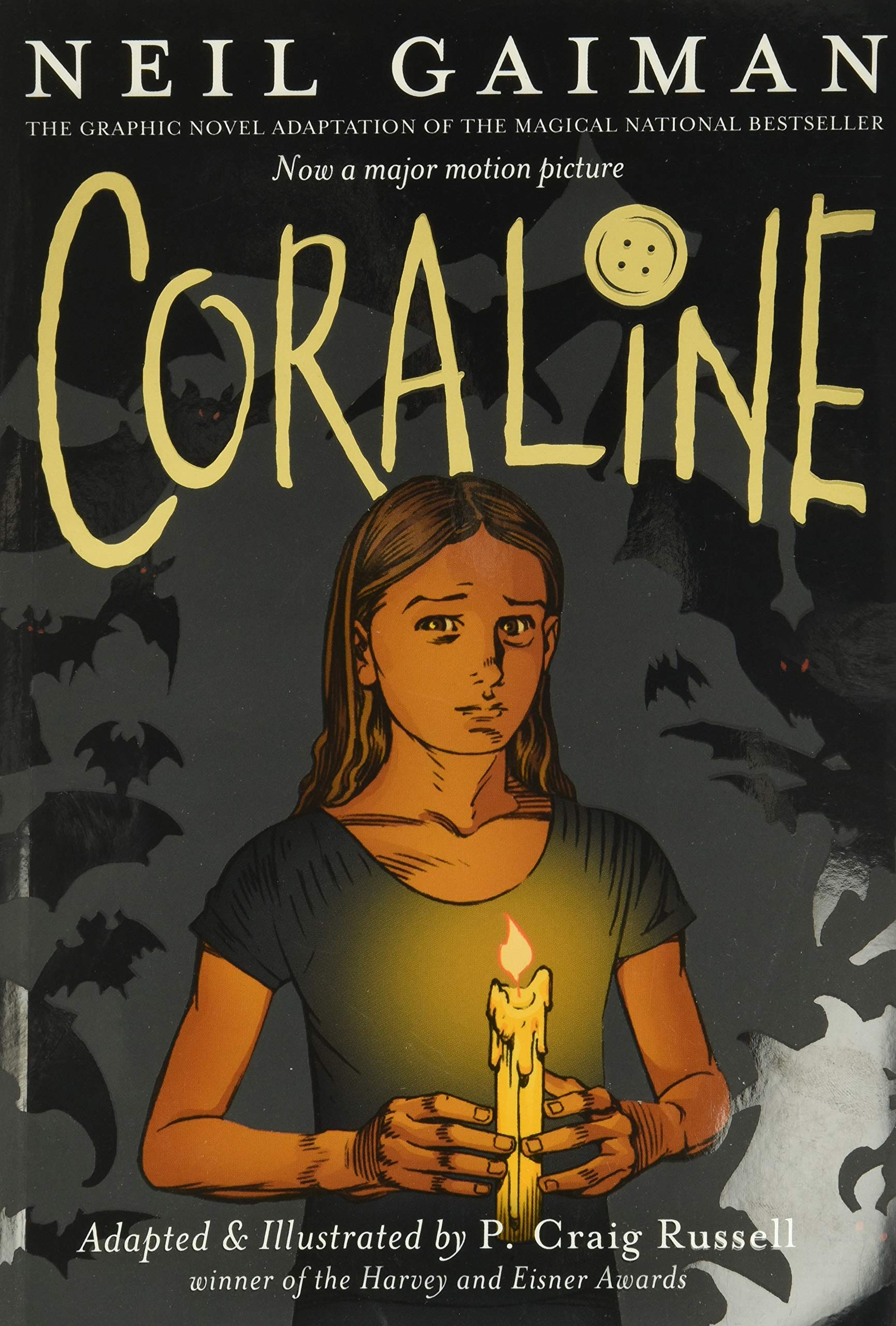
by Neil Gaiman
adapted & illustrated by P. Craig Russell (2008)
2009 Eisner Award Winner (Best Publication for Teens)
In this graphic novel adaptation of the juvenile fiction novel of the same name by Neil Gaiman, a young girl finds a door to an alternate world that proves to be very unsettling. Although I have not read the novel, I feel this story nicely lends itself to the graphic novel format. Russell's illustrations look like they are out of a graphic novel for adults, proving that just because a book is for children the quality does not need to be lower nor does the art have to look more childish -- probably the reason he won the Eisner Award for this book. However, because of the realistic quality of the artwork, the book becomes even more frightening -- even for an adult reading it! As for the story itself, I like how the reality of the alternate universe is never quite explained. Coraline spent most of her days before discovering "the door" talking to her parents about her boredom so the validity of her adventure seems to be in question. It can be a fantasy book (which I know it is) -- but it can also be viewed as a child's over-active imagination and love for exploration filling in for her boredom.
In the classroom this book could be used in upper grades for a unit on graphic novels as narrative form. Students could use the text to look for recurring symbols (disguises and naming), how action is shown, and how the world is created through art, dialogue, and other elements. Graphic novels might be difficult to read as a class, so I would probably offer this as a choice novel for independent exploration. As a class acting could be incorporated into lessons about graphic novels, as there use of visual action and dialogue lends itself nicely to drama. Students could also do a comparative analysis between the graphic novel form of the book and its original format, or do a comparison between this graphic novel and another. Coraline uses text to describe a lot of Coraline's internal thoughts and feelings, as well as what is happening in some frames of the book -- which is quite different than books that only show outward action and dialogue, for example. A lesson on teaching literary devices with comics can be found here.
adapted & illustrated by P. Craig Russell (2008)
2009 Eisner Award Winner (Best Publication for Teens)
In this graphic novel adaptation of the juvenile fiction novel of the same name by Neil Gaiman, a young girl finds a door to an alternate world that proves to be very unsettling. Although I have not read the novel, I feel this story nicely lends itself to the graphic novel format. Russell's illustrations look like they are out of a graphic novel for adults, proving that just because a book is for children the quality does not need to be lower nor does the art have to look more childish -- probably the reason he won the Eisner Award for this book. However, because of the realistic quality of the artwork, the book becomes even more frightening -- even for an adult reading it! As for the story itself, I like how the reality of the alternate universe is never quite explained. Coraline spent most of her days before discovering "the door" talking to her parents about her boredom so the validity of her adventure seems to be in question. It can be a fantasy book (which I know it is) -- but it can also be viewed as a child's over-active imagination and love for exploration filling in for her boredom.
In the classroom this book could be used in upper grades for a unit on graphic novels as narrative form. Students could use the text to look for recurring symbols (disguises and naming), how action is shown, and how the world is created through art, dialogue, and other elements. Graphic novels might be difficult to read as a class, so I would probably offer this as a choice novel for independent exploration. As a class acting could be incorporated into lessons about graphic novels, as there use of visual action and dialogue lends itself nicely to drama. Students could also do a comparative analysis between the graphic novel form of the book and its original format, or do a comparison between this graphic novel and another. Coraline uses text to describe a lot of Coraline's internal thoughts and feelings, as well as what is happening in some frames of the book -- which is quite different than books that only show outward action and dialogue, for example. A lesson on teaching literary devices with comics can be found here.


