Showing posts with label Young Adult Novel. Show all posts

Thursday, June 2, 2011

Blue Jasmine

Blue Jasmine
by Kashmira Sheth (2004)

            Seema feels she is being pressured to stay with her kaka and kaki in India despite the fact that her parents are moving to Iowa City for her father's new job. But when she decides to move to America she realizes it is not the pressure from her cousin and grandparents that make her feel like she is far from home. Seema faces challenges as she tries to learn a new language, make new friends, and deal with a bully in school -- but on top of all of this she misses her homeland greatly. But with the help of a neighbor she discovers a flower that smells like India's jasmine, but is a stunning blue color that she has never seen before. It is a flower that represents the two different places that she loves, and the people from each place who keep her happy. Sheth's symbolism throughout the book is striking, and tone of the book is consistently positive. Although issues with bullies and their resolutions seem somewhat contrived, the realizations that Seema makes through an impoverished friend back in India make the text seem deft and convincing.
            This book is much less dark than some other novels about immigration I have read -- and for this reason might be an excellent introduction for younger students in third or fourth grade that want to learn about the struggles an immigrant girl might face in the United States. This book, however, portrays dilemmas that children of all backgrounds face, so I believe that many students will relate to the main character despite their differences. Although resolved a little too perfectly, this book addresses bullying and allows readers to consider the issues from two perspectives, so this could be discussed in class. This book perfectly addresses being an outsider in a new place, as well as dealing with the differences faced for a four-year-old coming to the States and a 12-year-old doing the same. For these reasons I have chosen to include it in my text set about modern immigrant families.

Wednesday, June 1, 2011

Something About America

Something About America
by Maria Testa (2005)

            Maria Testa's poetry in this book, which reads much like prose with a defined sense of rhythm, explores so many different issues:  finding home in a foreign land, what it means to be American, the relationships between parents and children, the realities of war, and so many others. The simple language choice nicely reflects how the 14-year-old narrator might write to herself, but the way the stanzas are composed and the way the words combine make her voice come alive. The girl writing the poems feels she is fully American, yet the scars that cover her body up to her chin make it hard for her parents to forget their home in Yugoslavia, especially after 9/11 when neighboring communities want to run immigrants out. But the girl wants her parents to make themselves welcome, and her new motto is "If you can't find the welcome mat when you arrive, put one out yourself."
            This book covers the complex relationship between parents and children, especially in immigrant families where being American sometimes seems like leaving the past behind and forgetting where you came from. A similar contradiction -- trying to live a life that is not too American and not too foreign -- is also found in An Na's A Step From Heaven. I have chosen to include both texts in my text set about modern immigrant families. Something About America is also short enough that it would make a good read aloud, with either the instructor doing the reading or students practicing reading free verse poetry.
Home of the Brave

Home of the Brave
by Katherine Applegate (2007)

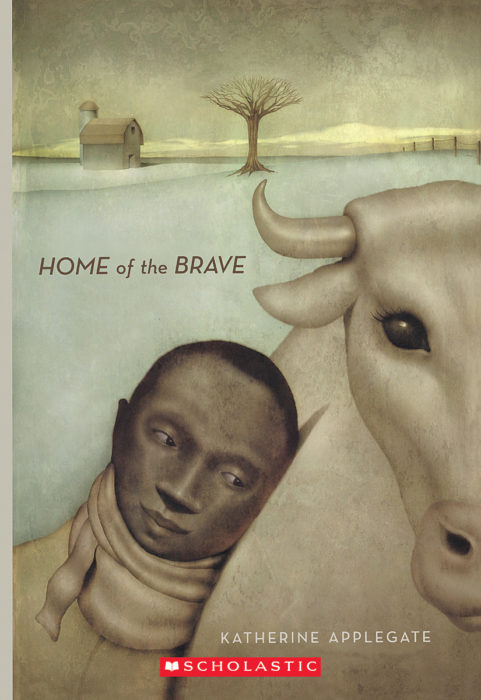
            I had never read a novel of this length composed entirely in free verse poetry, but Applegate's word choice combines the style of a child in a new place with poignant and lush imagery. This is the story of Kek, a Sudanese refugee with no father and brother and a missing mother, who has just moved to the United States to live with an aunt and cousin who are also scarred from the war they left behind. Kek faces new struggles in America, but he finds friends in unexpected places, even a cow who begins to represent much of what he left behind. The stanzas powerfully convey the confusion Kek feels in huge grocery stores, laundromats, and school, but also the longing he feels for a home that no longer exists for him. "This is a light switch. / He pushes a tiny stick on the wall / and the room turns to night / then blinks awake. / In my old home / my real home / the sun gave us light / and the stars / watched us sleep." But it is partly this beautiful conception of his home in Africa that allows Kek to keep hoping his mother will return and allows him to begin building a new home for himself.
            This would be an excellent example of free verse poetry and word choice. Many of the stanzas have unusual but effective adjectives and metaphors: "I have my father's will / my brother's eyes / and my mother's light. / She is like the newborn sun / fresh with promise / the just-beginning moments / before the day / fills like a bucket / with good and bad / sweat and longing." Kek's voice changes throughout the book, as well, as he learns English words for items that have no counterpart in his homeland, and as he gains confidence in his ability to define home. This book would also be an excellent addition to a unit on the struggles facing immigrants in the United States -- for this reason I have included it in my modern immigrant families text set.

Sunday, May 29, 2011

The Mysterious Benedict Society

The Mysterious Benedict Society
by Trenton Lee Stewart (2008)

2010-2011 Iowa Children's Choice Award winner

            What an amazing read! I flew through this 500 page book in just two days. The plot was exciting and the word choice often hilarious, but the character development really held my attention. Reynie, Sticky, Kate and Constance are precocious and self-sufficient, but constantly surprising. Each child's journey revolves around learning to be less independent, though, and understanding that their new friends -- and humanity itself to a certain extent -- are really a family. Although children may not make the same connections as I did reading the text (the political satire implanted in the Emergency, and the disconcertingly Orwellian rules at the Learning Institute for the Very Enlightened, for example), the story itself is a wonderful blend of fantastical plot twists and strangely realistic characters. The book is recommended for children 9-12, but I believe a reader as young as 7 would enjoy this book as a read-aloud and older children and adults would still relate to the characters while making connections to other texts or the world itself. This book is probably intended for gifted students, but because the characters in the text are learning from each other there are vocabulary words and concepts that are literally defined (usually by Sticky) so there are ample learning opportunities for readers.
            This book is probably too long for a whole-class assignment and discussion, and many less advanced readers would probably be intimidated by the sheer mass of the volume. However, this is definitely a book I would recommend to individual students, advanced reading groups, and parents looking for something to read to their children after the Harry Potter series has been read through repeatedly. I personally think this would be a fantastically fun book to read aloud to students -- and even reading aloud a portion to a class as part of a book talk will likely spark students' interest. I know the first chapter made me want to read on. And now the first book made me want to read the other two as well.


It's even more fun knowing that Stewart is a graduate of the Iowa Writers' Workshop. I would also be interested in reading his novel Flood Summer.

Thursday, May 26, 2011

The Misfits

The Misfits
by James Howe (2003)

          This book was a laugh. Howe's (or I should say Bobby's) word choice made tough situations seem light and light situations seem profound. The mix between simple sentences and complex word choice represents symbolically, to me, the time in a kid's life when he doesn't feel like a kid anymore, but certainly doesn't feel like an adult. Since this book is largely a coming-of-age story, I feel that the style is very appropriate. The moral is an important one -- that a group of kids can help end name-calling, even for a week -- but what I took from the book was the need for a community of 'misfits.' The term almost lacks meaning in the book, because regardless of how the Gang of Five is marginalized by the 'fits' they always have each other. Throughout the book the name-calling was almost peripheral to the group of kids, because they had already taken an internal stand against it. Through their campaign they gave a voice to other students who, perhaps, were not as outspoken as they were. There are points where Addie's understanding of race was upsetting for me, but I realize that almost all characters outside of Bobby are somewhat stereotyped or at least classified based on singular traits. It shows that even the best intentioned of the students are not free from bias or incapable of passing judgment. The end fell into place a little too perfectly and a little too quickly, but it can be overlooked for the overarching messages in the book.
          I feel this book has a very important place -- especially in the middle school classroom. I think that every student will be able to connect with some character in the book and it will be a mirror for them to think about how they interact in their own school environment. An awareness of bullying is the first step in trying to end it in school. The fact that this book is controversial is ridiculous to me and I would encourage as many students as I could to read it (even if in my first years of teaching I was too scared to do a read-aloud!). This book is a great introduction for a discussion of bullying and I think principals and school districts should recommend it to the student body, not hide it from them. The complaints about this book promoting a homosexual agenda are idiotic, to say the least, and the adults making these outrageous claims in Pleasant Valley and elsewhere are exactly the type of characters that this book is trying to take a stand against. Every person feels like a misfit sometimes, but every person deserves to feel like they fit in. And this book is a perfect springboard for a lot of kids to feel part of a group -- even if they start feeling like the fifth member of the Gang of Five.

          Interview with James Howe
          Article: "Using The Misfits to discuss sexual orientation issues"
          Class dicussion guide

Coraline: The Graphic Novel

Coraline
by Neil Gaiman
adapted & illustrated by P. Craig Russell (2008)

2009 Eisner Award Winner (Best Publication for Teens)

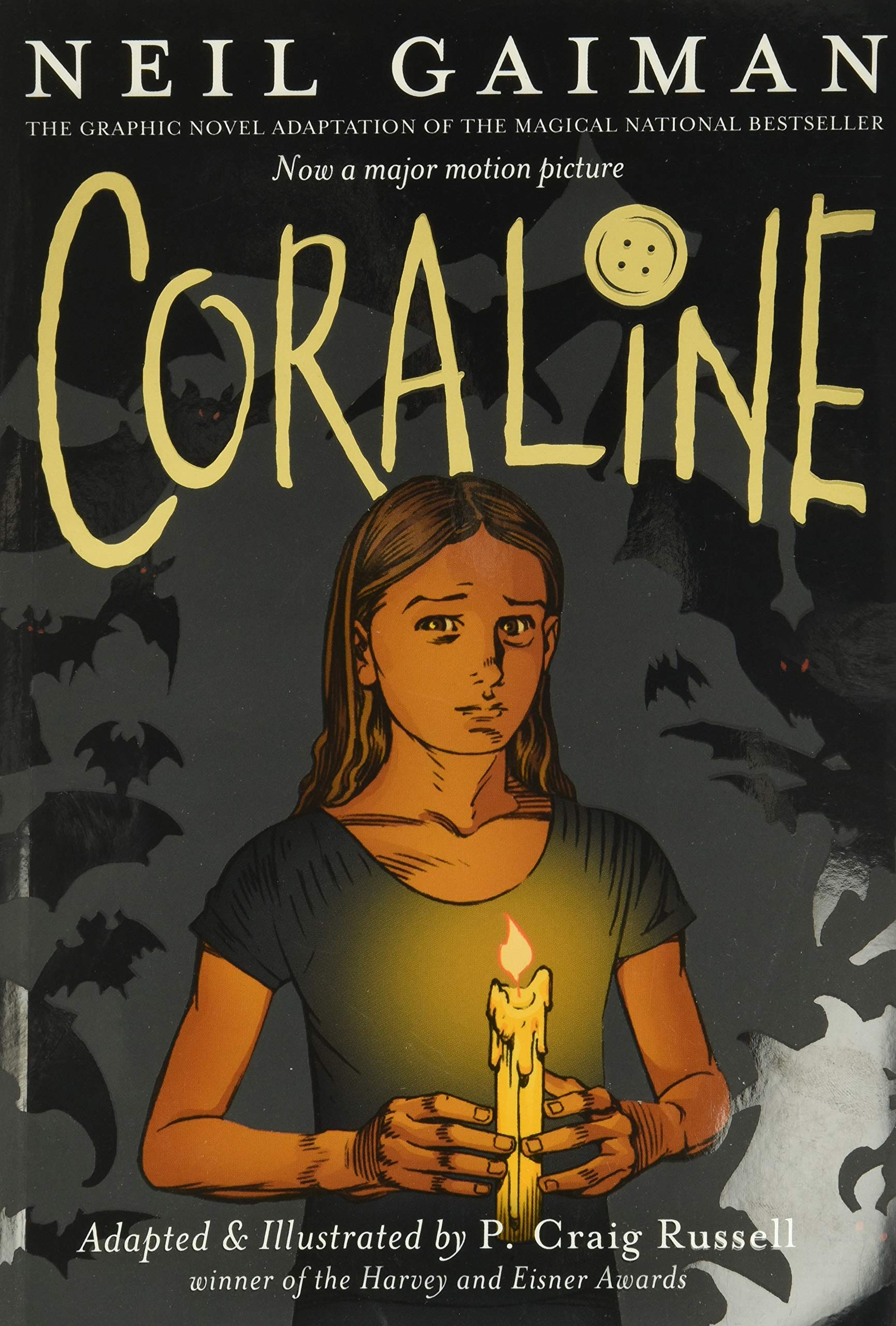
          In this graphic novel adaptation of the juvenile fiction novel of the same name by Neil Gaiman, a young girl finds a door to an alternate world that proves to be very unsettling. Although I have not read the novel, I feel this story nicely lends itself to the graphic novel format. Russell's illustrations look like they are out of a graphic novel for adults, proving that just because a book is for children the quality does not need to be lower nor does the art have to look more childish -- probably the reason he won the Eisner Award for this book. However, because of the realistic quality of the artwork, the book becomes even more frightening -- even for an adult reading it! As for the story itself, I like how the reality of the alternate universe is never quite explained. Coraline spent most of her days before discovering "the door" talking to her parents about her boredom so the validity of her adventure seems to be in question. It can be a fantasy book (which I know it is) -- but it can also be viewed as a child's over-active imagination and love for exploration filling in for her boredom.
          In the classroom this book could be used in upper grades for a unit on graphic novels as narrative form. Students could use the text to look for recurring symbols (disguises and naming), how action is shown, and how the world is created through art, dialogue, and other elements. Graphic novels might be difficult to read as a class, so I would probably offer this as a choice novel for independent exploration. As a class acting could be incorporated into lessons about graphic novels, as there use of visual action and dialogue lends itself nicely to drama. Students could also do a comparative analysis between the graphic novel form of the book and its original format, or do a comparison between this graphic novel and another. Coraline uses text to describe a lot of Coraline's internal thoughts and feelings, as well as what is happening in some frames of the book -- which is quite different than books that only show outward action and dialogue, for example. A lesson on teaching literary devices with comics can be found here.

The Giver

The Giver
by Lois Lowry (1993)

 1994 Newbery Medal winner, 1996 William Allen White Award winner

         The Giver is a magnificently written soft science fiction novel for young adults that incorporates many concepts found in classic dystopian literature for adults, especially Aldous Huxley's Brave New World and the short story "Harrison Bergeron" from Kurt Vonnegot's Welcome to the Monkey House. In Lowry's story the the Committee's decision making process seems straight from Kafka or Orwell's 1984, where they convene in committee about an issue for so long that the population forgets it was ever an issue. The contradictions in the society become apparent as Jonas begins to discover the truth behind the facade of the community, and as he begins to receive memories of societies past. The precision of language that is instilled in all children from an early age becomes laughable when it is realized that the oft-used "release" really means killing members of the community. On top of that is the contradiction of their painless society, the contradiction of talking about emotions when they are not even understood, and the contradiction of the utopian society in itself. This book makes you rethink what freedom and choice really mean. There's no question why this book won the Newbery Medal and continues to be a favorite choice in classrooms.
         I believe that writing of this caliber should be introduced to children in upper elementary school. This book offers a perfect opportunity to explore symbolism and perspective, among other literary elements. Not only can this book be used to show an example of excellent writing for young adults, but it can also be used as a starting point for creative writing assignments. For example, students may choose to try to write a detailed description of an important memory to them -- in a way that the reader might feel they are being "given" the memory. Some adult readers think that parts of the book may be too complex for elementary students -- but I remember reading it in 5th grade and it had a profound impact on me, even though certain parts were not read in depth and connections to other texts were not made. Other adults feel that this book is controversial because of 'graphic' scenes of euthanasia -- but The Giver allows students to think critically about our own society and what freedom truly means.

Friday, May 20, 2011

One Crazy Summer


One Crazy Summer
by Rita Williams-Garcia (2010)

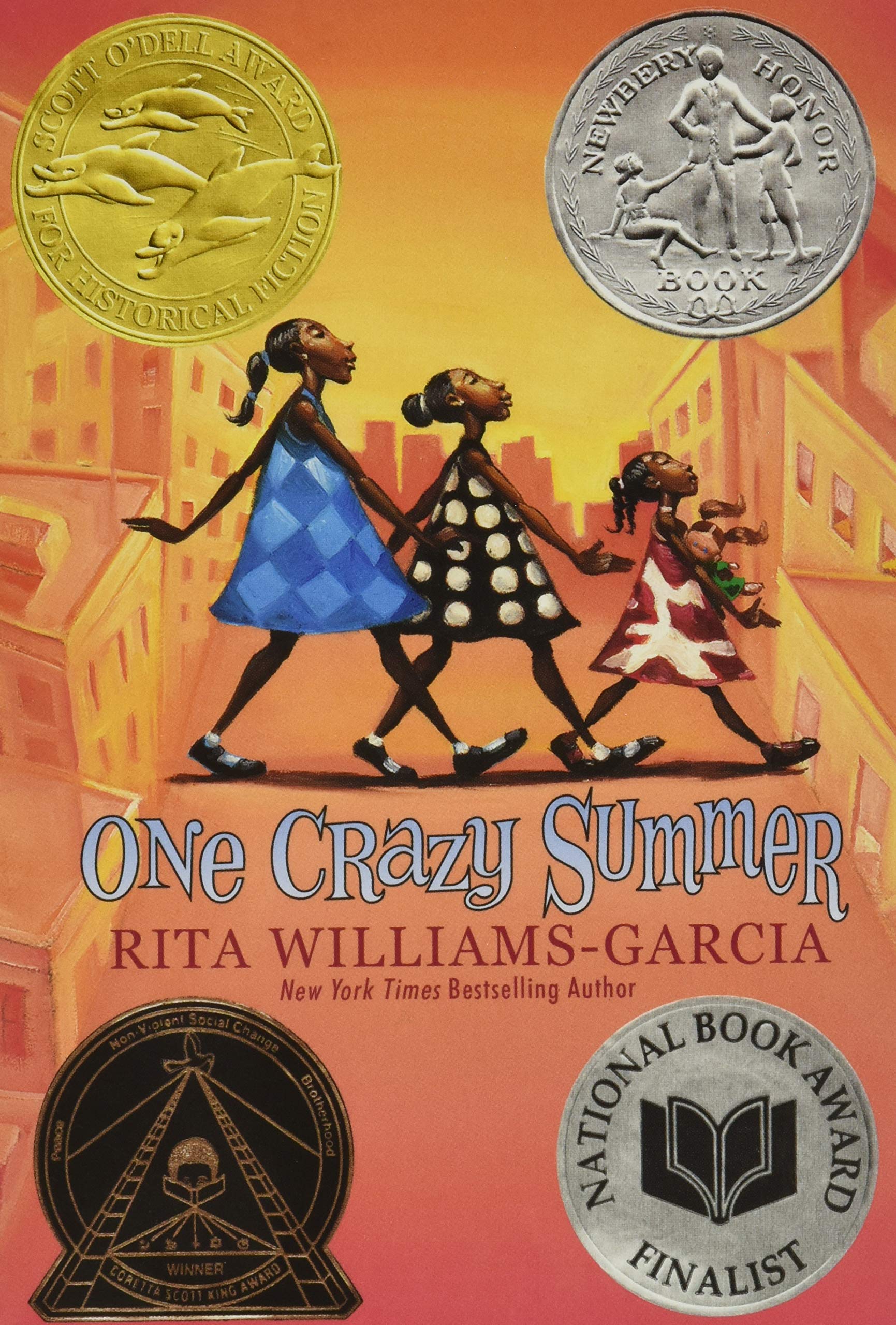
2011 Newbery Honor Award recipient, 2011 Coretta Scott King Award, 2011 Scott O'Dell Award for Historical Fiction

         Williams-Garcia's book One Crazy Summer shows an amazing breadth of cultural and historical information, but this is embedded in a book which is poignant and personal. It is beautifully written, but still has the voice of its 11-year-old narrator Delphine, who feels she needs to be a representative of her race. This means completely different things when she's at home in New York with her Pa and Big Ma, compared to when she's staying with her Black Panther poet mother Cecile (or "Nzila") in Oakland California. But it is not only about discovering what it is to be black in America, but what it means when your mother abandons you as a child. The multi-layered storytelling and the complexity of emotion make this an excellent read for fourth grade students or adults alike. In addition to the excellently crafted story, Williams-Garcia has excellent word choice. The power of words is important in this book -- as proven when Delphine is arguing with Brother Kelvin about whether her and her sisters are 'black' or 'colored' girls -- and the narration uses juxtaposition of these concepts of self identity through phrases and adages representing the dichotomy between black and colored, new and old, urban and country.
         This book would be a great book to use in class when talking about the civil rights movement, including the Black Panthers, or any late 1960's American history. As Delphine says in the book, you never saw middle-aged female Black Panthers teaching classes in a summer school to a group of hungry kids in the news. The Black Panthers were always represented as a violent and radical group. I believe a lot of these ideas about the movement still exist in the present day -- and this book covers a number of aspects of the movement from Delphine's perspective. Although she is not completely on board with the movement and is a somewhat skeptical narrator, she represents an honest viewpoint that students could easily understand. On top of the historical aspects in the book, One Crazy Summer also shows struggles in terms of family and self-identity -- for African Americans, but also for any children coping with absent family members. All students could use this text to explore perspective in writing. How would this story be different if it was written from the perspective of the absent mother, Cecile? What parts of her story are we missing because it is narrated by Delphine? How would Big Ma write about Cecile or vice versa?

A Step From Heaven

A Step From Heaven
by An Na (2001)

2002 ALA Printz Award Winner

          A Step From Heaven is a text that covers amazing ground for a young adult book. The story is rich, complex, and dramatic without being insincere. An Na weaves in metaphors of God and flight and floating that all point towards feelings of faith and hope in a new land. Although the United States does not turn out to be the heaven Young Ju expected, the young narrator still uses these feelings and images as allegories of hope. The author seamlessly changes voice from a four-year-old's narration to an adult's, and shows personal growth as hope despite the fact that Young Ju's life is often stagnate because of her home life. This book was a powerful read that pulled together memories of the past and hopes for a better future.
         This book covers domestic violence and might therefore be controversial or inappropriate in certain classrooms. I do believe, however, that students should read and discuss a book that offers a perspective which not only covers abuse in families, but also the difficulties of being an immigrant. Young Ju is simultaneously encouraged to be an American girl but stifled at every turn because this image contradicts the image of a good Korean girl. The text also raises questions about the different ways that girls and boys are viewed in different cultures. There are so many discussions that need to be had that can be encouraged through this text. Christy Yingling discusses ways to approach these topics in the classroom here.